
Searching Clinton County Criminal Dockets
Start a Clinton County criminal docket search at Indiana MyCase. The site covers Clinton Circuit Court, Clinton Superior Court, and Frankfort City Court. Got the cause number? Use it. Otherwise, narrow a name search to Clinton County. Pick Criminal & Citation, choose the likely court and status, and set a sensible filing-date range. Remember that what you see is a public view of Odyssey data. It is not a certified Chronological Case Summary.
Keep the citation, summons, or court notice handy. A case transfer can change the cause number. Citation numbers follow no single statewide format. Check the court segment first: 12C01 means Circuit, 12D01 means Superior, and 12H01 means Frankfort City Court.
- Enter the exact cause number, or use the individual-name path with narrow filters.
- Select Clinton County and Criminal & Citation; use the Frankfort City filter when named on the notice.
- Match court, case type, filing date, and status before opening the case.
- Read the newest CCS entries for current charges, settings, disposition, and sentence.
- Call or visit the clerk for an absent public filing, official balance, or certified copy.
MyCase caps any result set at 1,000 records, and repeated searches can trigger a captcha. A tight query saves you from scrolling through false matches. If something on the portal conflicts with your notice, trust the newest signed order or a clerk confirmation over the screen.
Clinton Criminal Docket Court Codes
Read the court segment before the charge label. A Clinton County criminal docket starts to make sense. County code 12 comes first. Then a court code follows, along with date, case type, and sequence details. The prefix simply routes the file to the right place. It says nothing about how serious the offense was, and it never states the result.
- 12C01
- Clinton Circuit Court, the local-rule destination for felony filings.
- 12D01
- Clinton Superior Court, the local-rule destination for misdemeanors, infractions, and ordinance cases.
- 12H01
- Frankfort City Court for matters within that lower court's jurisdiction.
Codes like CF, CM, MC, PC, IF, OV, and RF narrow the route a case travels. Treat them as filing and display keys, nothing more. Read the charge itself, any amendments, and the judgment before deciding what a code means about a Clinton County case.
Inside a Clinton Criminal Docket
Open a Clinton County case file and you will usually hit the Chronological Case Summary first. It lists every judicial event in date order, one entry stacked on the next. Indiana Trial Rule 77 puts the clerk in charge of keeping it, along with the case file, the Record of Judgments and Orders, and the indexes that tie the docket together.
| Header | Court and code, cause number, case style, type or level, filing date, status, and judge. |
|---|---|
| Charges | Count, cited law, offense text, level, date, and original or amended filing. |
| Bond and Pretrial | Public bond terms, warrants or holds, motions, and setting changes. |
| CCS Events | Filing, service, arraignment, plea, conference, motion, trial setting, order, and continuance. |
| Disposition | Trial or plea result, dismissal, diversion, judgment, sentence, costs, restitution, and closure. |
| Documents | Links to public charging, sentencing, final-order, or other permitted documents. |
| Cross-References | Appeal, transfer, reassignment, post-conviction cause, or related citation number. |
Money figures deserve a second look. Public dollar amounts on a docket can lag behind what the court actually owes, so get an official balance from the clerk before you rely on one. A screen print proves nothing; only a certified judgment carries that weight. The Indiana CCS and RJO guide draws the same line between the event summary and the signed order behind it.
Clinton Charges Versus Dispositions
A charge on a Clinton County criminal docket is only an accusation. It records what the State alleged at the time of filing. The same docket may later show an amended information. It may also show a dismissed count, a guilty plea, a bench or jury result, diversion, or an acquittal. So read the whole arc: start at the initial filing, follow each dated change, and end at the judgment.
Read the last controlling entry. A motion asks the court to act, a plea records a position, and a signed judgment states the adjudicated result.
Sentencing sometimes lands on its own date. Scan the Clinton County docket for the sentence itself. Credit time, probation, costs, restitution, and any later violation or completion entry belong there too. Treat "closed," "dismissed," and "deferred/diverted" as three different things. Copy the CCS text and date exactly as written.
Bond entries have limits as well. An amount or a forfeiture tells you what the court ordered at that moment. It does not establish guilt, and a later modification or recall can change the record.
How a Criminal Case Moves
A docket grows line by line. Papers come in, events happen, and the clerk adds each one. Nothing in that sequence promises a trial. A continuance may add another setting, an amended charge can change a count, and the plea and the sentencing might land on different dates entirely.
Clinton County criminal docket flow: Filing → Arraignment → Pretrial → Plea or Trial → Disposition → Sentencing.
Read the header first, then the opening filing. From there, trace the trail: service or warrant entries, the initial hearing, the plea, bond, motions, and every setting after that. Pull the disposition apart from sentencing and final completion. Transfers, appeals, special-judge assignments, and post-conviction work can each spawn a new case number, so expect more than one thread.
One caution. A hearing that was continued stays in the case trail; it does not mean the Clinton County criminal docket was dismissed.
Clinton Criminal Filings in 2024
How busy were these courts? The certified Indiana Court Online Reports counted 1,482 new criminal filings across Clinton County courts in 2024. Felonies, misdemeanors, miscellaneous criminal matters, post-conviction cases, and red-flag cases all sit inside that total. It measures workload, nothing more. It says nothing about unique people or how any one case is likely to go.
Circuit recorded 840 criminal filings. Superior recorded 640. Those counts mirror how the local caseload splits between the two benches, so picking the right court matters in any Clinton County criminal docket search.
Courts That Hold Criminal Dockets
Which Clinton County court holds a criminal docket depends on the charge. Under Clinton County's local rules, Circuit Court takes the felonies. Misdemeanors go to Superior Court. Infractions and ordinance violations also belong in Superior. The exception is a citation from Frankfort City Court. So one criminal docket search in Clinton County can span more than one courtroom.
The Clerk of the Circuit Court keeps the records for both courts. The state directory places Circuit at 355 Courthouse Square, 765-659-6345. Superior sits at 320 Courthouse Square, 765-659-6341. The county also lists 765-659-6340 for Superior. Frankfort City Court can be reached at 301 E Clinton Street, 765-654-5715.
The Indiana Judicial Branch Clinton County page gathers the local rules, MyCase, and e-filing. It also adds court statistics in one place. It shows which handles what.
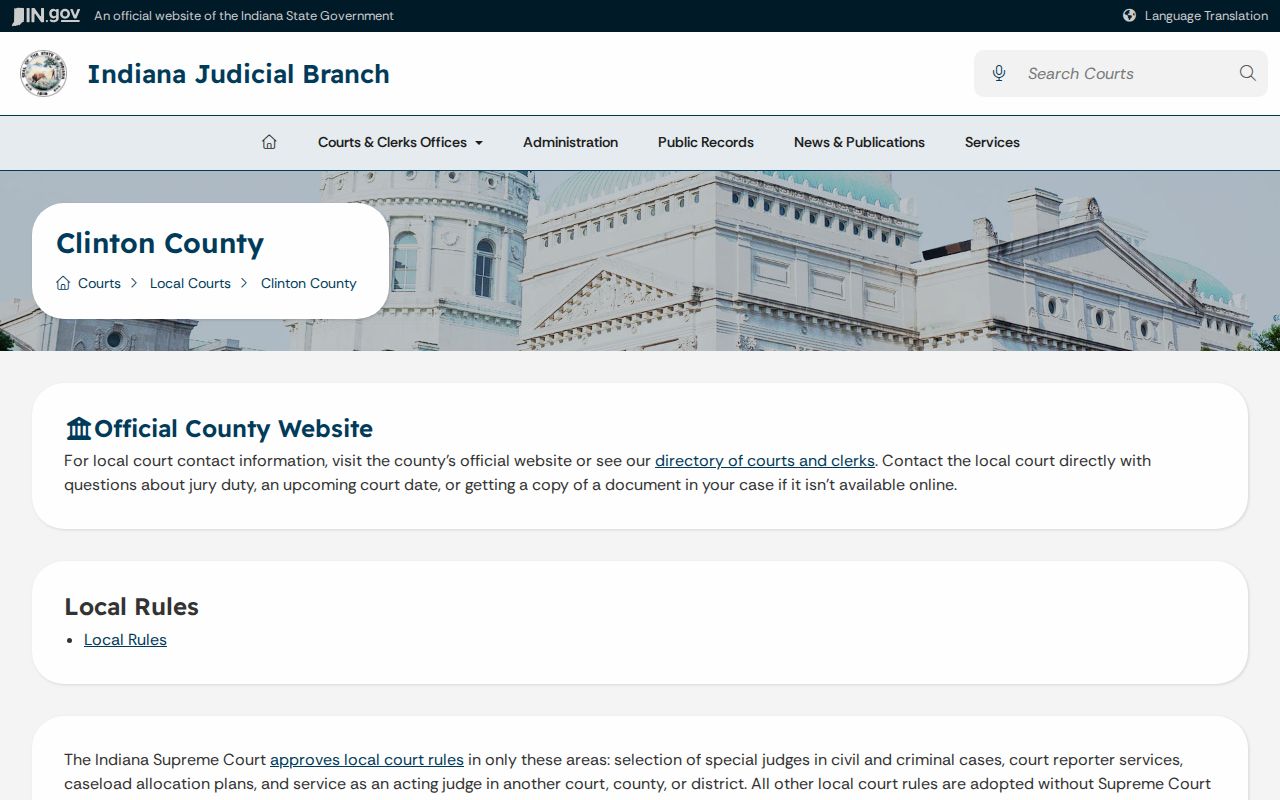
The state page helps route a search. The cause number and CCS identify the court holding the criminal case.
Older Clinton Criminal Docket Files
Start with MyCase, but a converted or older matter may show thinner detail there. Doxpop gives a second search plus a county-linked hearing view. It warns that it is not the official record. When those fall short, go back to MyCase. The Clerk of the Circuit Court is the next stop, and Clinton County Archives too if the clerk sends historical files there.
For documents without a link, certified copies, current balances, or sealed-access questions, try one place. The clerk counter and phone are the answer. Put any written request in terms of the cause. List the court, document or date, copy type, contact, and how you want delivery. Call first. The county charges no separate search fee. It posts no local criminal-copy form.
The county commissioners page gives an official view of county government.

The page adds local context, but Clinton County court records come from the clerk, court, reporter, or archive named in each matter.
Clinton Criminal Docket Settings
A setting can be an arraignment, pretrial, plea, motion, status, bench trial, jury trial, sentencing, or review. MyCase lists the date, time, type, judge, and location. The Clinton clerk page adds a "Look up Hearing" link through Doxpop. Handy, yes, but only a convenience view.
Keep the notice you received. Read the newest CCS entry and the signed order. If a date is close, call the court itself about time, location, continuance status, and whether you must appear. The prosecutor and probation office have separate roles; neither keeps the official Clinton County criminal docket.
The prosecutor can explain deferral. Probation can explain how to route supervision payments. Court reporters handle transcripts, and certified judgments come from the clerk.
Sealed Dockets and Public Access
Most nonconfidential Clinton County criminal docket material is searchable in MyCase. Still, a blank result does not mean no case exists. Sealed, expunged, juvenile, and other protected records may simply be absent, and public access to documents varies by case type.
Key access rules:
Access Rule 4 sets the public baseline unless an exclusion applies.
Access Rule 5 identifies confidential and sealed categories.
Access Rule 9 provides the verified extraordinary-access process.
Ask the court whether a public order or redacted version exists. A request for an excluded record must go to the court with jurisdiction, and the record stays confidential until a written ruling. Knowing a cause number does not authorize release.
Indiana Code 5-14-3 supplies the general public-records framework. Court records also follow Supreme Court Access Rules. Bulk data runs through the Office of Judicial Administration, not a one-case clerk request.